Moisture mapping, not guesswork
We use moisture meters and thermal imaging checks where appropriate to find wet building materials behind baseboards, under flooring, and around cabinets.
Serving Seattle, Washington & surrounding areas
Water Damage Restoration · Auburn, WA
Fast response for leaks, burst pipes, and flooding, with a clear plan to dry, clean, and repair your property the right way.
When water gets into floors, drywall, or insulation, time matters. Water spreads, materials swell, and damp cavities can turn into mold conditions quickly. Project Mesa Restoration provides water damage restoration Auburn property owners can rely on when a supply line breaks, an appliance overflows, a water heater leaks, or stormwater finds a way inside.
We start by stopping the source when possible and documenting what happened, then we move straight into extraction, structural drying, and targeted removal of water-damaged materials. The goal is simple: get the building dry to a verified standard and leave you with a solid repair plan.
Although our office is in Seattle (98101), our crews operate as a water damage restoration team across Seattle, WA and respond throughout the south end, including Auburn homes and local commercial spaces.
Drying, Cleanup & Repair Planning
We use moisture meters and thermal imaging checks where appropriate to find wet building materials behind baseboards, under flooring, and around cabinets.
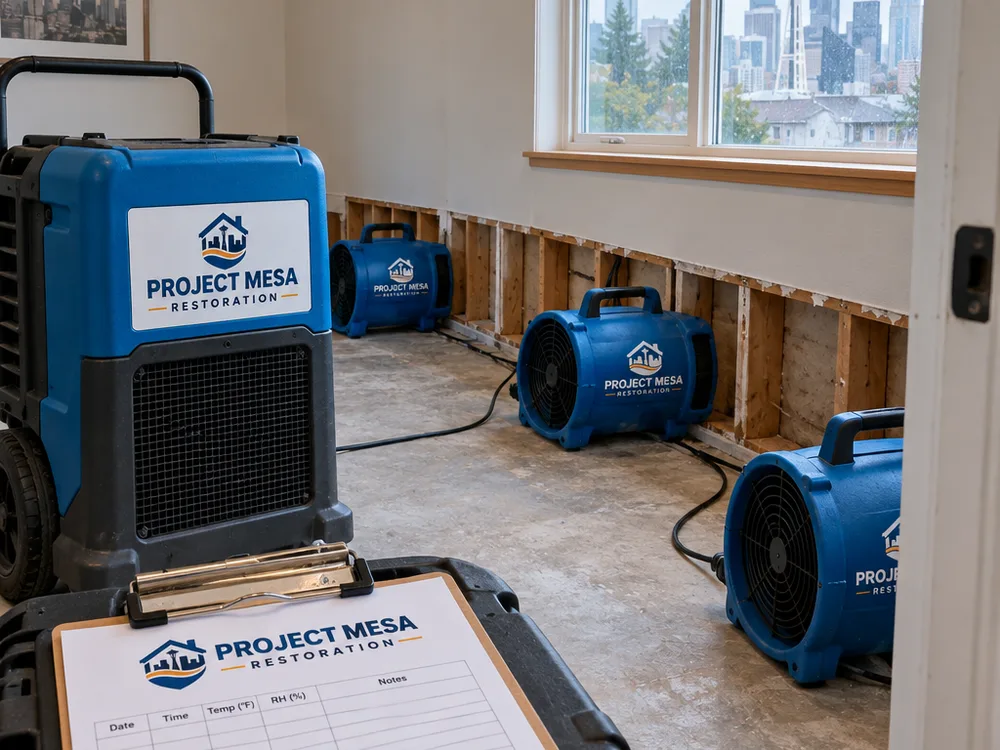
Air movers, dehumidifiers, and containment are set based on the affected area so drying is effective without causing unnecessary dust or disruption.
Once drying is underway, we outline what can be saved, what must be removed, and what the rebuild steps look like, including trim, drywall, flooring, and paint.
Clean water, gray water, and sewage backups require different handling. We follow the right safety and cleaning approach for the water category involved.
We capture photos, readings, and drying logs so there is a paper trail for claims and for your own records.
We protect walk paths, isolate dusty demolition when needed, and keep equipment placement practical for daily living or business operations.
Find the Hidden Moisture
A small leak rarely stays small. Water follows gravity and the easiest path: under floating floors, along joist bays, behind toe-kicks, and into wall cavities at plumbing penetrations. In Auburn, many properties have a mix of slab-on-grade areas and framed floors. Both can hide moisture in different ways.
During inspection we look for:
If the water is contaminated, such as a sewage backup, the plan changes. Materials that cannot be cleaned safely are removed, the remaining structure is cleaned and disinfected, and drying happens after the environment is controlled.

From Emergency Control to Repair
We identify the source and immediate hazards, including electrical, slip, and contamination risks. If the water source is still active, stopping it comes first.
Standing water is removed using pumps or truck-mounted extraction. Wet drywall, pad, or other unsalvageable materials are removed when they prevent proper drying.
We place dehumidifiers and air movers to create consistent airflow and humidity control. Moisture readings are tracked so drying is verified, not assumed.
Surfaces are cleaned based on the water category and affected materials. Odor control and antimicrobial treatments are used when conditions call for them.
After dry standards are met, we define the repair scope: drywall and texture, paint, baseboards, flooring transitions, cabinets, and finish carpentry. You get a straightforward path to put the space back together.
Extraction, Drying & Rebuild
Water damage restoration in Auburn typically ranges from about $1,500 to $7,500 for common residential losses, with small, contained clean-water incidents sometimes closer to $800 to $2,000 and larger multi-room or contaminated-water projects running $8,000 to $25,000+.
Final pricing depends on how far the water traveled, the category of water, how much demolition is required to dry correctly, equipment days, and the repair scope for drywall, flooring, and cabinetry. Exact costs are confirmed after an onsite inspection and moisture mapping.
Customer Proof
“A pipe let go under our kitchen sink and water got under the flooring. The crew explained what had to come out, set up drying equipment the same day, and kept checking moisture until it was truly dry. The repair plan was easy to understand and there were no loose ends.”
“We had a laundry overflow that soaked into the wall behind the baseboards. They found moisture we would never have seen, removed only what was necessary, and left the space clean and safe while it dried.”
Practical Answers
Tell us what happened and where the water reached. We'll assess the damage, explain what can be saved, and give you a written scope for drying, cleanup, and the repairs needed to restore the space.